Einstürzende Neubauten at the Odeon of Herodes Atticus: When Noise Becomes Memory, Art and Ritual
By Malice F. (Fotini Gavriilidou).
On June 18, 2026, Einstürzende Neubauten will perform at the Odeon of Herodes Atticus, as part of the Athens Epidaurus Festival, for one of those nights that cannot be easily contained within the simple word “concert”.
There are bands you listen to. There are bands you watch. And then there are Einstürzende Neubauten — one of those rare artistic phenomena that you do not merely “see” live, but experience like a crack in time, like a breathing mechanism, like a building slowly collapsing before your eyes only to be rebuilt with different material. And somehow, they have always managed to do exactly that: to create an otherworldly atmosphere and to rebuild their own substance again and again, with new material, for more than 45 years. The way they do this is admirable. And deeply magical.
On June 18, the Odeon of Herodes Atticus will host a meeting almost unimaginable in its intensity: ancient stone, the memory of the city, the ritual silence of the venue, standing opposite a band that, for decades, has been transforming metal, air, body, fracture and noise into high art. The Athens Epidaurus Festival presents them after 2024’s Rampen, describing them as an ensemble one “owes” it to oneself to encounter at least once in a lifetime — and in this case, the exaggeration is not an exaggeration.
Einstürzende Neubauten were never merely “industrial pioneers”, however convenient that description may be. From West Berlin in 1980 — a place and time where, as difficult as everything was, it also felt as if everything was possible — until today, they have been something more difficult and far more dangerous: a language. A language that took urban ruins, tools, metals, self-made instruments, decay and the unease of Europe, and turned them into music. Their official biography rightly notes that they are among the few German bands to have sent a truly distinctive and internationally influential artistic signal into the world, affecting not only music, but also dance, visual arts and cinema.
And perhaps this is what matters most: Einstürzende Neubauten never settled for simply “playing” differently. They were never concerned with other people’s opinions during the creation of their art, nor with following a movement. They changed the very idea of what rhythm could be. They became the movement themselves. They changed the idea of what stage presence could be. In a world that often consumes revolution as style, Neubauten remain disturbingly real: not because they reproduce the chaos of their early years, but because they continue to metabolise it. They make it more mature, more subterranean, more precise. Not less dangerous.
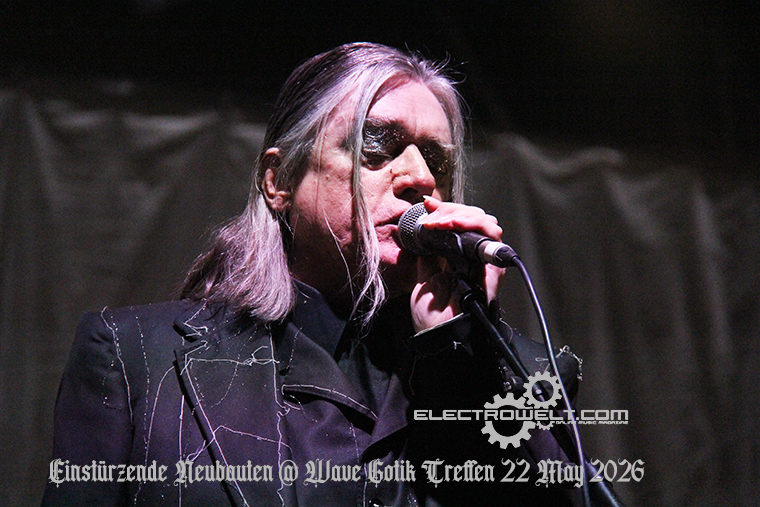
This became clear once again recently at Wave-Gotik-Treffen 2026 in Leipzig, where I was fortunate enough to see them live once more. In a festival that often exists within an overwhelming abundance of choices, Neubauten did not function as just another “big name” in the line-up. They functioned as a magnetic field. As a reminder that the dark scene was not born only out of melodies, clubs and aesthetics, but also out of ruptures, experimentation, and the courage to listen to the city creaking and realise that this sound is pushing you somewhere.
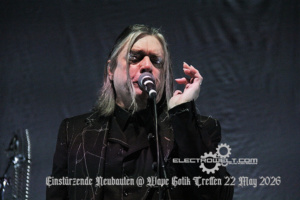
Their appearance at WGT 2026 was recorded among the major events of the festival, with their presence at the packed Agra also captured in recent photographic features from the event. At WGT, I did not feel I was watching a historic name simply honouring its past. I felt I was standing before a living organism that still produces intensity and awe with absolute control. I felt that I was witnessing, once again after all the times I have seen them live, the creation of art and the sensation of ritual. With an incredible setlist and Blixa theatrical yet deeply expressive in his simplicity, we experienced, among others, “Pestalozzi”, “Ist Ist”, “Möbliertes Lied”, “Die Befindlichkeit des Landes”, “Sabrina”, “How Did I Die” and, as part of the encore, the magnificent “Stella Maris”.
And of course, at the centre of this story stands Blixa Bargeld. Not only as the voice and figure of Neubauten, but as one of the defining presences of the dark European avant-garde. His presence in Nick Cave and the Bad Seeds is not a mere biographical footnote. It is a link between two worlds that profoundly shaped dark music culture: on one side, the post-industrial deconstruction of Berlin; on the other, the dramatic, almost biblical post-punk universe of Nick Cave. Blixa brought with him that cold metallic radiance, that threatening elegance, that sense that a guitar or a voice does not have to “accompany” a song — it can wound it and haunt it at the same time.
On stage, Blixa Bargeld has nothing to prove. His voice — at times a whisper, at times a sharp incision, at times an almost theatrical delivery — remains one of the most recognisable instruments of the European avant-garde. Around him, Neubauten build and deconstruct with their unique discipline: nothing is accidental, even when it seems to be born in the moment. Noise is not decoration. Silence is not emptiness. Metal is not a gimmick. Everything is part of a ritual that forces you to watch and listen with your entire body.
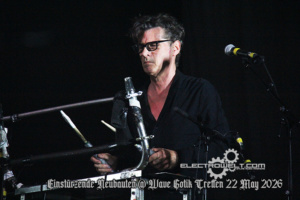
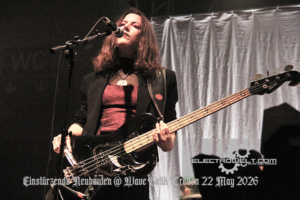
The band’s current phase is also particularly interesting. After the departure of Alexander Hacke in 2025, Neubauten entered a new chapter with the addition of Josefine Lukschy on bass — their first new addition to the line-up since 1997, according to a recent Guardian feature. In that same context, Bargeld essentially makes it clear that Neubauten are not in an epilogue, but in continuation; not in museum-like representation, but in movement.
And this is crucial for their upcoming performance at the Odeon of Herodes Atticus. We are not talking about a nostalgic visit from a legend of the past. We are talking about an active artistic entity carrying more than four decades of history, yet still treating sound as material to be discovered. Rampen is not a “comeback” album in the easy sense of the word. It is a work born out of improvisational live passages, revealing a band that is still searching, still listening, still allowing the mechanism to generate life through friction.
The Odeon of Herodes Atticus, on the other hand, is not merely an impressive historical venue. It is a place that imposes and provokes awe and memory. This is why the presence of Einstürzende Neubauten there takes on an almost symbolic character. Ancient architecture facing deconstruction. Stone facing metal. History facing the sonic trauma of the 20th and 21st centuries. And somewhere in between, us — listeners, viewers, witnesses — watching a ritual that does not promise easy emotion, but something much rarer: transformation.
Einstürzende Neubauten are important because they opened a path where there was no path. Because they proved that beauty can be found in the uncomfortable, the unfamiliar, the broken. Because they gave industrial sound not only form, but spirit. Because they influenced generations without ever becoming easily imitable. And because, even today, they do not feel like “heritage” — they feel like a warning.
My own relationship with Einstürzende Neubauten is not theoretical, nor does it begin from a detached need to explain their historical importance. It begins from that first, almost physical collision with their sound; from the moment when “Tanz Debil”, “Feurio!” or “Installation” did not simply sound like songs, but like something that shifted the way I perceived music, especially as I was discovering the dark scene’s true diamonds. It was as if a crack suddenly opened and you understood that industrial, when it carries authentic depth and substance, is not simply noise or a “hard” sound.
For me, Einstürzende Neubauten were never just an “industrial” band. They were the moment I understood that industrial, as I feel it and define it, is not merely a sound. It is matter. It is weight. It is metal, concrete, breath, scream, silence, rhythm that does not always dance, but moves you internally.
I will never forget the first time I heard “Feurio” at Berlin bar in Thessaloniki, the moment I discovered their now famous “little man” logo and the childlike handwriting of the band’s name. That feeling of something both primal and urban awakening from the ruins, with an almost apocalyptic intensity. Or “Installation”, where sound does not seem to be performed, but assembled in front of you like a dark object of art. That was always their magic: they did not write songs in the conventional sense. They built spaces. Structures. Ceremonies. Mechanisms of memory and tension.
In terms of live experience, my initiation into Einstürzende Neubauten coincided with their first appearance in Greece, during the promotion of Ende Neu, at Mylos in Thessaloniki on October 14, 1997. For the record, the following day, October 15, 1997, they were scheduled to perform at Rodon in Athens, but that concert was cancelled.
I also remember them in Athens in 2010, during their double anniversary appearance at Fuzz Club for their 30th anniversary, with the image of Blixa Bargeld performing barefoot on stage remaining indelible. Minimal, almost ritualistic, as if he were not simply “performing” the sound, but inhabiting it.
And of course, there was also their last Athenian appearance before the Odeon, in 2017 at Gazi Music Hall. A night that, even if it had the character of a journey through their history, never felt like a museum retrospective. Neubauten, even when they return to landmark pieces, do not exhibit them like relics; they reactivate them, within the space and within the moment.
This is why Neubauten carry such unique gravity in the dark and avant-garde scenes. Not because they easily belong to them, but because they changed their conditions. They opened a space where intensity did not need to be noisy in order to be extreme. Where industrial was not a mechanical cliché, but a living, dangerous process of transformation.
To see Einstürzende Neubauten at the Odeon of Herodes Atticus is not something that concerns only the already initiated. It concerns every spectator who wants to experience a live event beyond the ordinary. Even if one does not know their discography, even if industrial or avant-garde seem like difficult words, this night matters because it brings together one of the most influential living myths of the European avant-garde and one of the most historically charged venues in Athens. Neubauten do not simply offer songs. They offer sound as matter, performance as ritual, darkness as art. And at the Odeon, this may become something truly unrepeatable.
On June 18, at the Odeon of Herodes Atticus, we are not simply going to see a legendary band. We are going to listen, to discover — no matter what musical background we come from — the city remembering, metal speaking, silence opening, and sound becoming once again something dangerously alive.
Einstürzende Neubauten are not coming to entertain us. They are coming with honesty — and with the intent to shift something within us.